





Leipzig, 17–19 September 2026
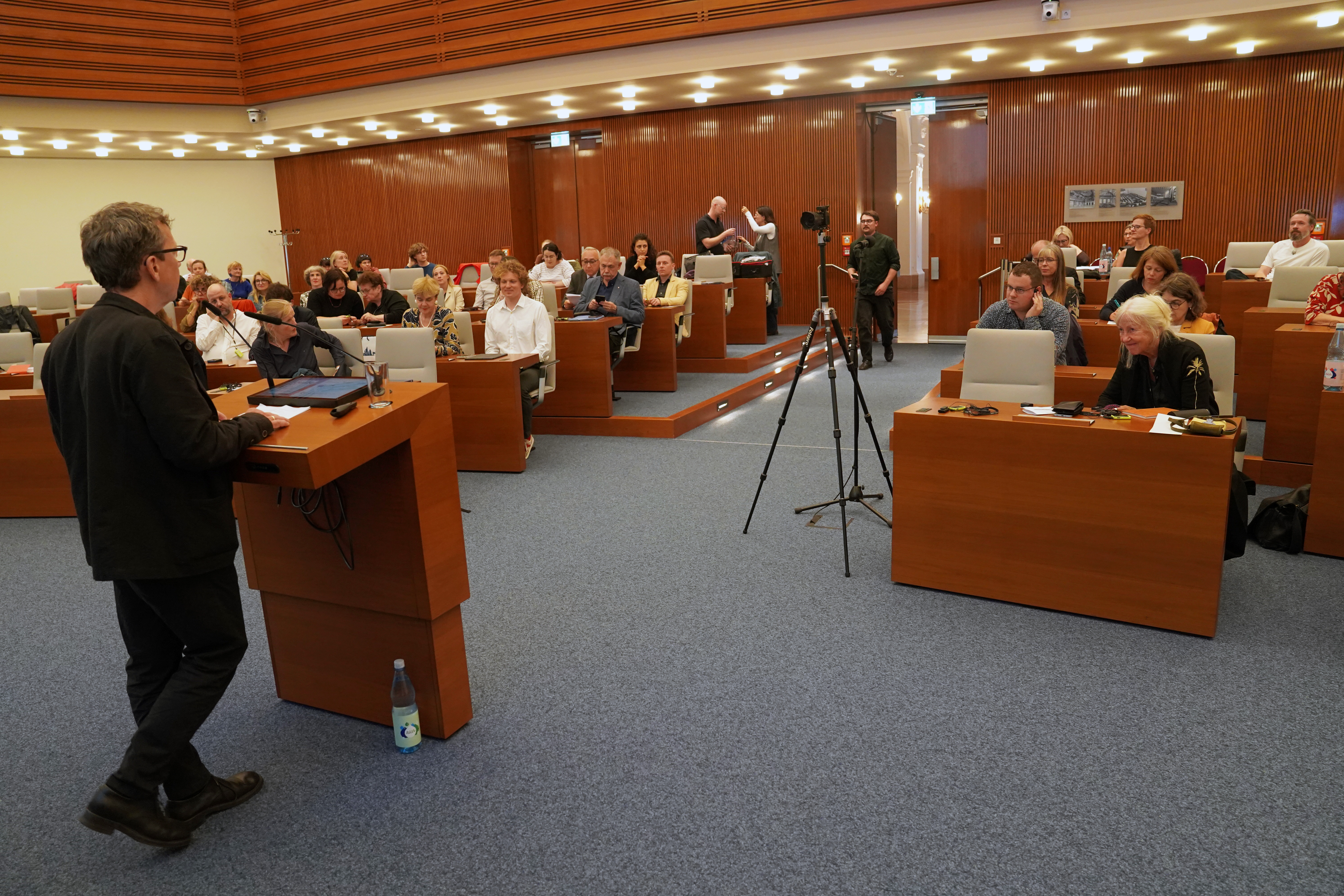
Building on the workshop “Surveying the Destruction, Repairing, Reconstructing: A New Building Culture for Ukraine?” held in Leipzig on 3–4 April 2025, this follow-up event was devoted to recent developments in architecture and urban planning under wartime conditions.
The programme opened with the public lecture “Urban Development under Wartime Conditions: Lessons from Lviv” by Anton Kolomieitsev, Chief Architect of Lviv. The lecture addressed the development of infrastructure for internally displaced persons (IDPs) and Lviv’s role as a transit hub, as well as the creation of a barrier-free urban environment and rehabilitation infrastructure. It also discussed longer-term strategic planning, including the integration of the railway system into the European network, cycling infrastructure and brownfield redevelopment. Further topics included recent developments such as the expansion of office space and cultural projects, including the Jam Factory, the adaptation of existing infrastructure to current needs, and commemoration projects. Finally, the Lviv Urban Forum was presented as a platform for exchanging experiences and ideas.
The workshop focused primarily on Ukrainian cities while also taking a comparative look at experiences of war and reconstruction in Bosnia and Herzegovina and the Middle East. It brought together experts from academia, architecture, urban planning, heritage conservation and civil society. By establishing a platform for exchange and comparative research, the workshop fostered cooperation between Ukraine and other countries with experience of war.
The programme was divided into three thematic sessions, each combining short expert presentations with a moderated discussion.
The first session focused on local, often small-scale reconstruction activities. Particular attention was paid to heritage preservation initiatives, including HEMO and its methodology for documenting destruction, local repair initiatives in Lviv, and the case of Aleppo, where the discussion addressed community-building around destroyed heritage.
The second session addressed safety in the built environment. Against the backdrop of ongoing wars, the discussion considered not only short-term responses but also long-term architectural and urban-planning concepts. The session examined safety measures in housing competition projects and the protection of infrastructure, as well as unequal access to safe spaces in Israel.
The third session examined the provision of temporary infrastructure in response to forced migration and displacement. The discussion addressed the repurposing of existing dormitories to accommodate the needs of IDPs with disabilities and the role of historical heritage in bringing displaced communities together. The case of Bosnia and Herzegovina highlighted the challenges associated with return and the prospect of returning home after displacement.
Organizers: Leibniz Institute for the History and Culture of Eastern Europe (Prof. Arnold Bartetzky, Anastasiia Bozhenko, Anja Höfer), project cities building culture (consortium partners: Leibniz Institute for the History and Culture of Eastern Europe (GWZO), RWTH Aachen University and Karlsruhe Institute of Technology (KIT)), in cooperation with the Saxon Academy of Arts, the Urban Development and Building Department of the City of Leipzig, the Saxon State Chancellery, and Lviv Polytechnic National University.
Photos: © Klaus Michael